Daiko Matsuyama’s “My Awakening”: A Zen Monk on Choice, Teachers, and Reassurance
“My Awakening” is a column series presented by Asupresso that explores the turning points that shape each person’s life. In every installment, a special guest shares personal reflections on their own experience.
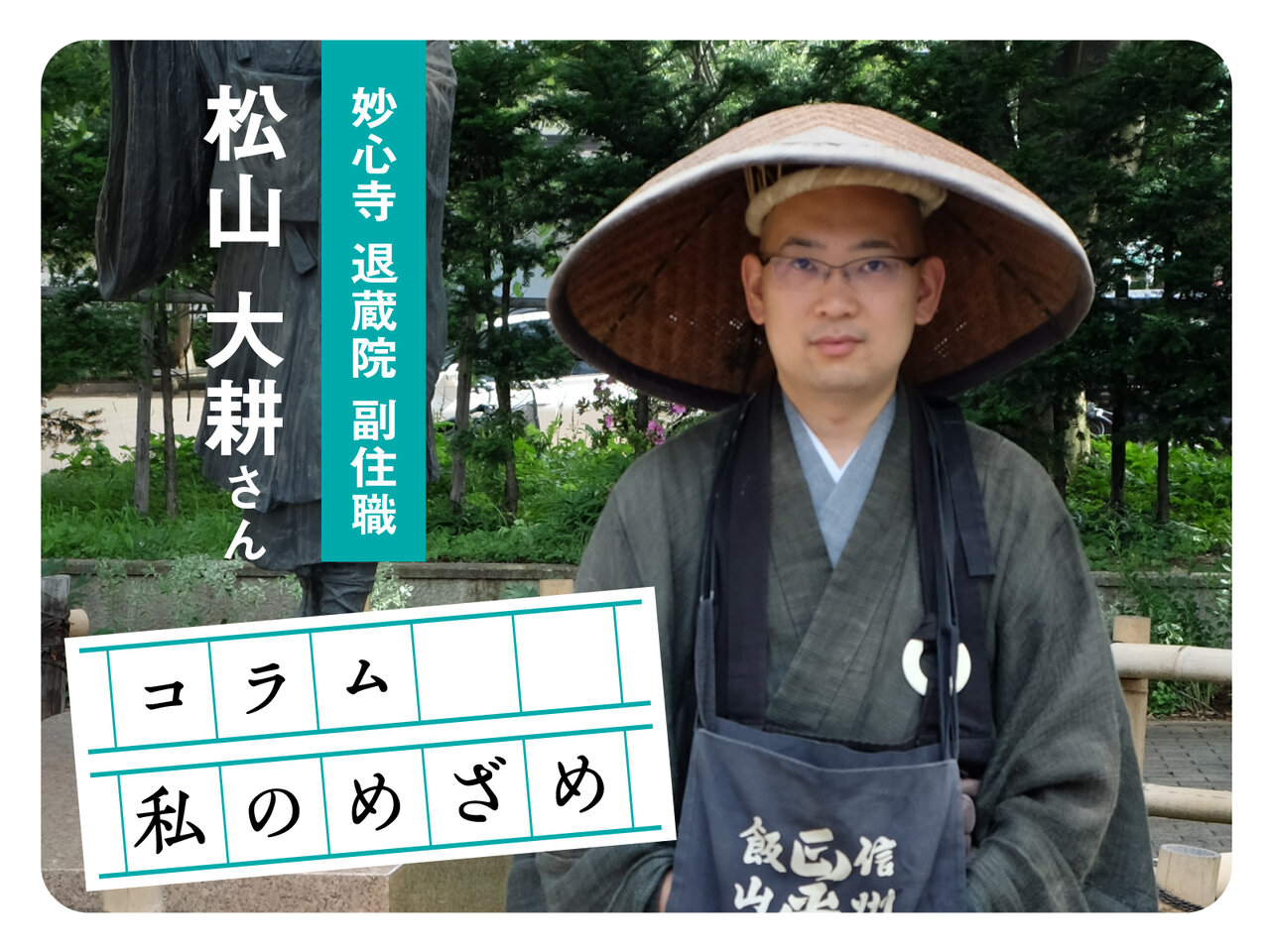
This installment is written by Daiko Matsuyama, Deputy Head Priest of Taizō-in in Kyoto.
Rev. Daiko Matsuyama (Deputy Head Priest of Taizō-in Zen Buddhist Temple)
Born in Kyoto in 1978, he completed his master’s degree at the University of Tokyo’s Graduate School of Agricultural and Life Sciences in 2003. After three and a half years of monastic training at Heirin-ji Temple, he became Deputy Head Priest of Taizō-in in 2007.
He has been widely recognized for his efforts to share Japanese culture both in Japan and abroad. He was appointed a Japan Tourism Agency Ambassador for the Visit Japan Campaign in 2009 and has served as a Kyoto City Tourism Ambassador since 2021. In 2016, he was selected as one of Nikkei Business magazine’s 100 People Shaping the Future and was named a Fellow of the US–Japan Leadership Program. His publications include Forget What’s Important First: 30 Zen Teachings for the Wavering Soul published by Sekai Bunka Publishing.
Questioning a Life That Seemed Predetermined
I did not grow up wanting to become a monk even though I was born as the eldest son of Taizō-in, a temple with more than 600 years of history. Taizō-in is one of the many sub-temples of Myōshin-ji Temple in Kyoto, the head temple of Japan’s largest Rinzai Zen Buddhist network which oversees nearly 3,400 affiliated temples nationwide.
My birthday falls during Rōhatsu Ōzesshin, the most demanding week-long meditation retreat in the Zen calendar. Next to our temple stands one of the strictest Zen training monasteries in Japan. As a child, my birthday was often accompanied by raised voices and scenes of intense training that left a deep impression on me. I remember thinking, quite honestly, what kind of place is this.
To be clear, Zen training today has changed significantly and physical violence is no longer part of the practice. At the time, those experiences made me feel strongly that I did not want to inherit the temple if becoming a monk meant enduring such hardships.
At school, classmates often asked “Why do you even study? You will inherit the temple anyway.” No matter how hard I tried, it felt as though my future had already been decided for me. That assumption troubled me deeply and I could not accept it.
Discovering Anshin Through an Unconventional Teacher
My outlook changed during graduate school at the University of Tokyo, where I was researching agricultural life sciences. I spent several months living with a farming family in a remote town in northern Nagano. While there, I found myself wondering whether a Myōshin-ji affiliated temple existed nearby. That curiosity led me to Shōju-an, a historic Zen temple in Iiyama.
It was there that I met Reverend Kandō Harai who would later become my spiritual teacher. Shōju-an stands in a region where winter snowfall can reach three meters, sometimes burying the temple’s first floor.
Most Zen temples in Japan are supported by the danka system, in which households (the danka) provide financial support to a temple in return for spiritual care and ritual services. Shōju-an, however, had no danka and received no income from tourism. Instead, it was sustained entirely through the traditional practice of mendicant alms rounds.
Takuhatsu, as it is called in Japanese, involves monks walking through town while chanting sutras and receiving small offerings of food or money. Even in modern Japan, surviving solely through this practice is extremely rare. Yet Rev. Harai not only maintained the temple in this way but also repaired damage from two major earthquakes using only the donations he had collected.
He was unlike any monk I had ever known. On one occasion, after being asked to conduct a funeral, he turned to me and said almost casually that he had forgotten the funeral sutras and asked me to take care of it instead. I was stunned. Later, I came to understand that conducting funerals is only one part of a monk’s role.
A local poet once wrote that when people hear Kandō-san’s takuhatsu voice, a sense of peace spreads throughout the town. That line stayed with me. It helped me realize that a monk’s true role is to bring anshin, a sense of reassurance and inner calm, to society.
If I were to describe Rev. Harai in a single phrase, he was someone from whom nothing could ever be taken. The temple was always left open and never locked and he greeted everyone with a gentle smile. He was deeply loved by the people of the town. Although he passed away several years ago, a statue of him performing takuhatsu now stands in front of Iiyama Station. He was truly an extraordinary presence.
I knew I could never become a monk of his stature. Still, his way of life convinced me that this path was worth pursuing. That realization marked my awakening and my decision to become a Zen monk.
Aspiring to Become Someone Who Brings Anshin
A middle school student once asked me what the best part of being a monk was. There are certainly challenges but there is also something deeply rewarding. In the Zen world, we are surrounded by sensei, teachers we can genuinely respect.
Many people assume that monks never struggle or feel discouraged. That is not true. Like anyone else, monks experience doubt and hardship. What makes the difference is the presence of rōshi, Zen masters who have trained for decades. When we sit with them, they often sense our concerns without our needing to explain and offer guidance that feels precisely right.
Most people lose that kind of mentorship after leaving school. To have such teachers even in adulthood is profoundly reassuring and one of the great blessings of this path.
As society changes, so do the forms of anxiety people carry. Yet the role of religion remains the same. It is to offer anshin, a sense of reassurance and inner stability. Monks must look outward, engage with society, and strive to offer even a small sense of comfort. That is what modern monks are called to do, and it is what I continue to aspire to become for others.